
Victor Brecheret
In English below
|
Bailarina, c. 1920 / Ballerina, c. 1920 Bronze fundido / Cast bronze 70 x 60 x 30 cm Acervo Câmara dos Deputados / Chamber of Deputies Collection |
|
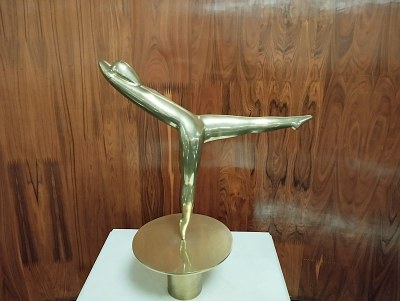
"Escultura em bronze polido, representando a fase parisiense do escultor, em que prevalecia a delicadeza das formas e a sutileza com que tratava os temas femininos. Nessa época (anos 20), morava em Paris e trabalhava ao lado de mestres como Bourdelle, que buscavam a beleza através do brilho. Seu trabalho demonstra alterações de forma e superfície, muito próximas das desenvolvidas por todos os artistas importantes desse tempo. Era uma busca de modo renovador de representar os temas tradicionais. Bailarina é uma das expressões mais importantes do período." (Sandra Brecheret Pellegrini)
Victor Brecheret
★ 1894, Farnese, Itália † 1955, São Paulo, SP
Veio ainda criança para São Paulo, onde iniciou sua formação no Liceu de Artes e Ofícios, estudando desenho, modelagem, entalhe e escultura. Em 1913 seguiu para Roma, permanecendo por cinco anos, período em que consolidou sua formação técnica influenciada pela tradição clássica, pelo naturalismo e pela linguagem de artistas como Michelangelo e Rodin. Ao retornar ao Brasil, em 1919, instalou seu ateliê no Palácio das Indústrias e rapidamente atraiu a atenção dos modernistas paulistas, que reconheceram em sua obra uma ruptura decisiva com o academicismo vigente. Em 1920 apresentou a maquete do Monumento às Bandeiras, mas a obra só foi reformulada e retomada em 1936 para ser finalmente inaugurada em 1953. No ano seguinte mudou-se para Paris com uma bolsa, e lá permaneceu por cerca de quinze anos, vinculando-se à produção escultórica europeia contemporânea, convivendo com artistas como Brancusi e Henry Moore, e participando de importantes salões. Mesmo ausente, integrou a Semana de Arte Moderna de 1922 por meio de obras enviadas ao evento. Foi um dos fundadores da Sociedade Pró-Arte Moderna (SPAM). De volta definitivamente ao Brasil em 1936, dedicou-se à execução do Monumento às Bandeiras e à construção de uma iconografia escultórica brasileira, incorporando referências da arte indígena, folclórica e religiosa. Nas décadas de 1940 e 1950 produziu numerosas obras públicas e esculturas em terracota, bronze e pedra. Considerado o introdutor do modernismo na escultura brasileira, Brecheret consolidou-se como uma das figuras centrais da arte do século XX no país.
______
About the artist
★ 1894, Farnese, Itália † 1955, São Paulo, SP
Victor Brecheret came from Italy to São Paulo as a child, and began his training at the Liceu de Artes e Ofícios, studying drawing, modeling, woodcarving, and sculpture. In 1913 he left for Rome, where he remained for five years, a period during which he consolidated his technical training under the influence of the classical tradition, naturalism, and the language of artists such as Michelangelo and Rodin. Upon returning to Brazil in 1919, he established his studio in the Palácio das Indústrias and quickly attracted the attention of the São Paulo modernists, who recognized in his work a decisive break with the prevailing academicism. In 1920 he presented the model for the Monument to the Bandeiras, although the work would only be revised and resumed in 1936 and finally inaugurated in 1953. The following year he moved to Paris on a scholarship, remaining there for about fifteen years, engaging with contemporary European sculpture, interacting with artists such as Brancusi and Henry Moore, and participating in important salons. Even in his absence, he took part in the 1922 Modern Art Week through works sent to the event. He was one of the founders of the Sociedade Pró-Arte Moderna (SPAM). After returning permanently to Brazil in 1936, he devoted himself to the execution of the Monument to the Bandeiras and to the development of a Brazilian sculptural iconography, incorporating references to Indigenous, folk, and religious art. In the 1940s and 1950s he produced numerous public works and sculptures in terracotta, bronze, and stone. Considered the introducer of modernism into Brazilian sculpture, Brecheret established himself as one of the central figures of twentieth-century art in the country.
About the sculpture
“Polished bronze sculpture representing the sculptor’s Parisian phase, in which delicacy of form and the subtle treatment of feminine themes prevailed. At that time (the 1920s), he lived in Paris and worked alongside masters such as Bourdelle, who sought beauty through brilliance. His work demonstrates changes in form and surface, very close to those developed by all the important artists of that period. It was a search for a renewed way of representing traditional themes. Ballerina is one of the most important expressions of the period.”
(Sandra Brecheret Pellegrini)
_____
Fonte / Source:
https://pt.wikipedia.org/wiki/Victor_Brecheret , em 14/6/19.
https://www.escritoriodearte.com/artista/victor-brecheret , em 14/6/19 (que teve como fonte: ANTONIA, Maria. Brecheret fala de arte. In: BRECHERET: 60 anos de notícia. São Paulo: s.n., 1976. p.93-95.)
https://enciclopedia.itaucultural.org.br/pessoa1634/victor-brecheret , em 14/6/19.