
Iberê Camargo
In English below
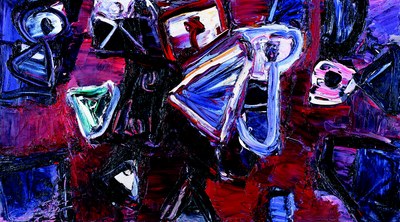
Pouso, 1973 / Landing, 1973
Óleo sobre tela / Oil on canvas
55 x 95 cm
Acervo Câmara dos Deputados / Chamber of Deputies Collection
Foto / Photograph - Rui Faquini
Iberê Camargo
★1914, Restinga Seca, RS †1994, Porto Alegre, RS
Pintor, gravador, desenhista e professor. Estudou pintura com Frederico Lobe e Salvador Parlagrecco na Escola de Artes e Ofícios em Santa Maria, RS. Entre 1936 e 1939, em Porto Alegre, fez o curso técnico de Arquitetura do Instituto de Belas Artes e estudou pintura com João Fahrion. Em 1942, transfere-se para o Rio de Janeiro. Freqüentou a Escola Nacional de Belas Artes. Em 1943, fundou, com outros artistas, o Grupo Guignard.
Recebeu prêmio de viagem ao exterior no Salão Nacional de Arte Moderna do Rio de Janeiro. Na Europa, estudou gravura em metal com Carlo Petrucci, pintura com Giorgio de Chirico, Antônio Achille, Leone Augusto Rosa e André Lothe. De volta ao Brasil em 1953, lecionou no Instituto Municipal de Belas Artes, no Rio de Janeiro, hoje Escola de Artes Visuais, onde fundou o curso de gravura em metal.
A partir de 1970 lecionou na Escola de Belas Artes da Universidade Federal do Rio Grande do Sul. Recebeu medalha de prata no Salão de Arte Moderna do Rio de Janeiro em 1954; em 1960, foi premiado na Bienal do México; em 1961, ganhou o prêmio de melhor pintor nacional na VI Bienal de São Paulo. Em 1986, recebeu o título de doutor honoris causa da Universidade Federal de Santa Maria.
Entre suas publicações, constam o artigo Tratado sobre Gravura em Metal e o livro técnico A Gravura. Em 1995, foi criada a Fundação Iberê Camargo, no Rio de Janeiro.
___
About the artist
★1914, Restinga Seca, RS †1994, Porto Alegre, RS
Painter, printmaker, draftsman, and educator. He studied painting with Frederico Lobe and Salvador Parlagrecco at the Escola de Artes e Ofícios in Santa Maria, RS. Between 1936 and 1939, in Porto Alegre, he completed the technical course in Architecture at the Instituto de Belas Artes and studied painting with João Fahrion. In 1942, he moved to Rio de Janeiro, where he attended the Escola Nacional de Belas Artes. In 1943, he co-founded the Grupo Guignard with other artists. He was awarded a travel scholarship at the Salão Nacional de Arte Moderna in Rio de Janeiro.
In Europe, he studied metal engraving with Carlo Petrucci and painting with Giorgio de Chirico, Antônio Achille, Leone Augusto Rosa, and André Lothe. Returning to Brazil in 1953, he taught at the Instituto Municipal de Belas Artes in Rio de Janeiro (today Escola de Artes Visuais), where he founded the metal engraving course. From 1970 onward, he taught at the School of Fine Arts of the Universidade Federal do Rio Grande do Sul.
He received a silver medal at the Salão de Arte Moderna in Rio de Janeiro in 1954; in 1960, he was awarded at the Mexico Biennial; and in 1961, he won the prize for Best National Painter at the VI São Paulo Biennial. In 1986, he was granted the title of Doctor honoris causa by the Universidade Federal de Santa Maria.
His publications include the article Tratado sobre Gravura em Metal and the technical book A Gravura. In 1995, the Fundação Iberê Camargo was established in Rio de Janeiro.